

Secondary Infertility and IVM: Treatment Options for Parents Trying for Baby Number Two

Having a child once does not guarantee it will happen again, and that reality catches many parents completely off guard. Secondary infertility, defined as the inability to conceive or carry a pregnancy after previously giving birth, is far more common than most people realize, and the emotional weight of it can feel especially isolating when the people around you assume the hard part is behind you. If this describes where you are right now, you are not alone, and there are real, effective options worth knowing about.
At Chedid Grieco, we work with parents navigating secondary infertility every day. Our approach to fertility preservation and treatment is built around personalized care tailored to each patient’s specific situation, not a one-size-fits-all protocol. With over 30 years of experience and more than 8,780 babies born through our care, we bring both depth of knowledge and genuine attentiveness to every case we take on.
Why Secondary Infertility Happens
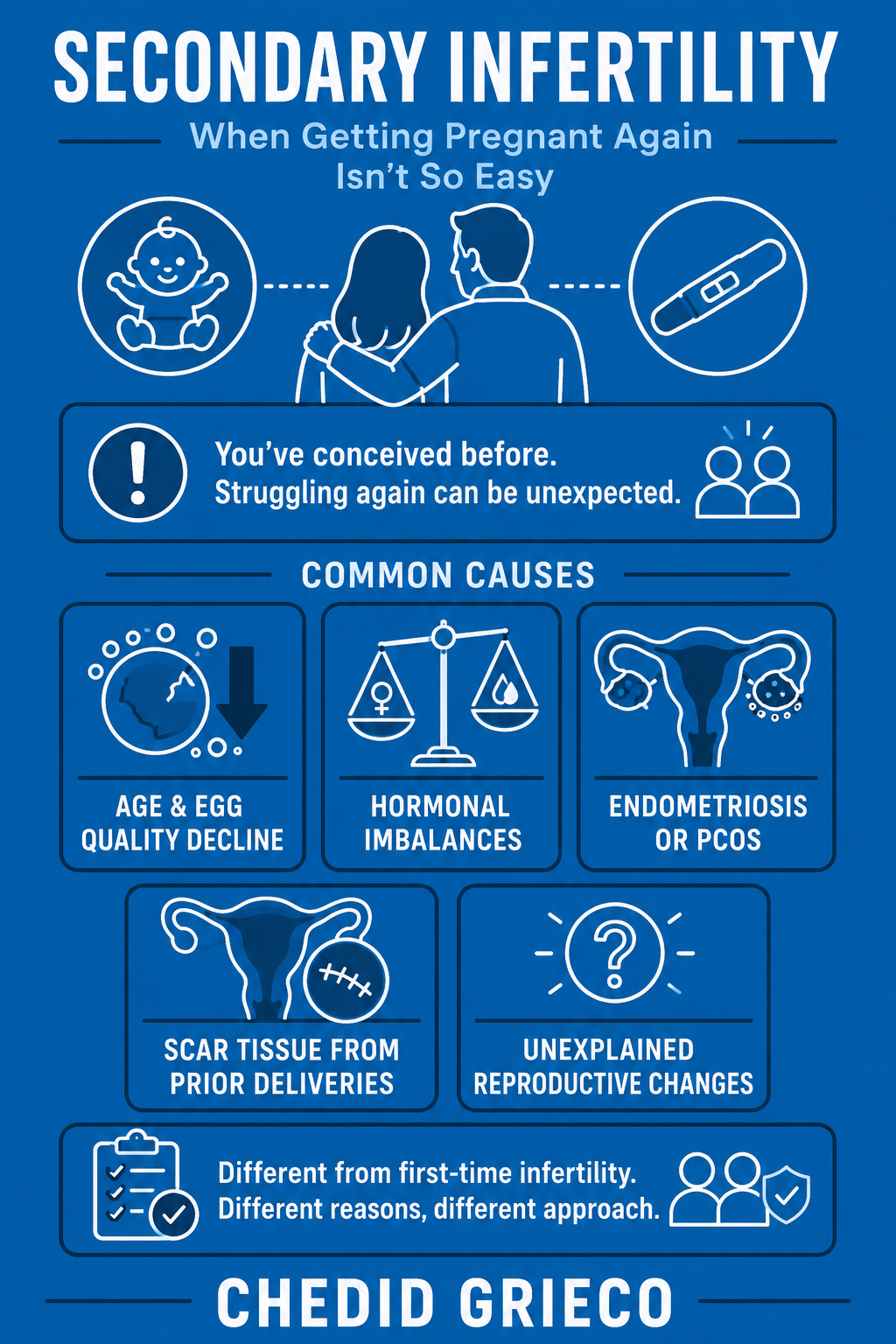
A previous successful pregnancy does not protect against the biological changes that can interfere with conception later. According to the American Society for Reproductive Medicine, infertility affects a significant portion of couples of reproductive age, and secondary infertility accounts for a substantial share of those cases. The causes often differ from what people expect.
Age is one of the most common contributing factors. Even a few years can meaningfully affect egg quality and ovarian reserve, particularly for women in their mid-to-late thirties. Other causes include changes in hormonal balance since the previous pregnancy, new diagnoses such as endometriosis or polycystic ovary syndrome, scar tissue from a prior delivery or procedure, and unexplained shifts in reproductive function. Because secondary infertility often has a different root cause than primary infertility, your evaluation and treatment plan may look quite different from what you did the first time.
Where IVM Fits In
In vitro maturation, or IVM, is an advanced fertility technique now available at Chedid Grieco that may be especially relevant for patients experiencing secondary infertility. IVM allows eggs to be retrieved from the ovaries before they are fully mature, then matured in the laboratory rather than inside the body. This means the process does not require the 10 to 12 days of hormone injections that standard IVF relies on for controlled ovarian stimulation.
For patients who had a difficult response to stimulation medications in a prior cycle, or those who are sensitive to hormonal protocols, IVM offers a gentler path to egg retrieval. It is also an option worth considering for patients with certain ovarian conditions where heavy stimulation may not be advisable. Our blog on how IVM works explains the science behind the process in more detail, and our post on who is an ideal IVM candidate walks through the clinical profile this approach suits best.
What the Treatment Process Looks Like
IVM at Chedid Grieco begins with an initial consultation at our Miami, Florida office, where Dr. Silvana Chedid and our team review your full reproductive history, prior pregnancy outcomes, and current diagnostic results. From there, a customized treatment plan is developed based on what is most likely to work for your specific situation.
The retrieval and maturation process takes place at our São Paulo, Brazil, laboratory, which is equipped with advanced reproductive technology. Because IVM eliminates most of the injection phase, many patients find the overall experience significantly less physically demanding than a conventional IVF cycle. Fertility treatments with minimal injections offer a closer look at what this reduced-stimulation path feels like in practice.
Learn More About Your Family Planning Options With Chedid Grieco
Secondary infertility deserves the same focused, individualized attention as any other fertility challenge, and the fact that you have conceived before does not make your current situation any less valid or any less treatable. Our team of eight dedicated doctors performs 1,200 cycles per year and is FDA and New York State-licensed, bringing a level of regulatory rigor that sets us apart from most clinics operating outside the United States.
Consultations are held at our Miami, Florida office, while treatments are conducted at our clinic in São Paulo, Brazil. Our fertility tourism model is designed to make cross-border care as straightforward as possible, and our multilingual team is available in English, Spanish, Portuguese, and French throughout the process. When you are ready to take the next step, reach out through our contact form to get started.
Recent Posts