

What Are the Benefits of Using Frozen Eggs
Medically Reviewed by Dr. Silvana Chedid on August 31, 2026
Frozen eggs give you a way to hold onto your reproductive potential at its current stage, so that if you decide to pursue pregnancy later through IVF, you are working with eggs retrieved during a younger, often more fertile period rather than eggs collected at whatever age you eventually try to conceive. The practical benefits that follow from that, more flexibility in timing, a wider range of options for building a family, and the ability to plan ahead of a medical treatment that could affect fertility, all trace back to one core idea: eggs frozen today do not continue to age the way the rest of the body does.
At Chedid Grieco, we have spent more than 30 years helping people decide whether egg freezing fits into their family-building plans, and fertility preservation is one of the more common reasons people first reach out to us. Some people come to us for personal reasons, such as not yet being ready to start a family. Others come to us ahead of a medical treatment that could affect their future fertility. Consultations take place in Miami, and treatment is carried out at our Brazil clinic under FDA and New York State Department of Health licensing standards.
Why People Choose to Freeze Their Eggs
Egg freezing tends to come up for one of two broad reasons, and it helps to think about which one applies to your situation before you get into the details of the process itself.
Building a Family on Your Own Timeline
Many people choose to freeze their eggs while they are still in their twenties or early thirties, before career changes, education, financial planning, or simply not having met the right partner yet have settled into place. Freezing eggs during this window does not commit you to using them. It gives you the option to use them later, on a timeline that reflects your own life rather than a biological deadline. Some people never end up using their frozen eggs at all, and that is a normal outcome of choosing to preserve options rather than a sign that the decision was wrong.
Others come to the decision later, sometimes after a relationship ends or after realizing that their current life circumstances are not yet ready for a family but may be in a few years. In both cases, the underlying goal is the same: separating the biological question of egg quality from the personal question of when you actually want to start trying to conceive.
Protecting Fertility Ahead of a Medical Treatment
Certain medical treatments and diagnoses can reduce future fertility, and people facing them often want to preserve eggs before treatment begins rather than after. This applies broadly, not to any one diagnosis or situation, and a reproductive endocrinologist can help you understand your own timeline if a treatment schedule is involved. We cover this topic in more depth in our overview of fertility preservation options before cancer treatment begins, which walks through how clinics coordinate around a treatment calendar.
How Egg Freezing Works
The process behind egg freezing is fairly consistent across clinics, though the details of monitoring and technique can vary. Understanding the general steps helps set expectations before you start.
Ovarian Stimulation and Monitoring
Egg freezing starts with a course of hormonal medication designed to stimulate the ovaries to produce multiple mature eggs in a single cycle, rather than the single egg the body typically releases each month. This stimulation phase generally runs for a week to ten days, and throughout it our team monitors follicle growth and hormone levels with bloodwork and ultrasound so the retrieval can be timed for when the eggs are mature. Monitoring appointments happen every few days, which is part of why the clinic that performs your cycle needs to be one you can reach conveniently during this window.
Egg Retrieval
Once the eggs reach the right stage of maturity, they are retrieved in a short outpatient procedure performed under sedation. A thin needle is guided through the vaginal wall to reach each ovarian follicle and withdraw the fluid containing the egg. The retrieval itself typically takes under thirty minutes, and most people return to normal activity within a day or two, though some mild cramping or bloating afterward is common. Eggs are examined in the lab immediately after retrieval to identify which ones are mature enough to freeze.
Vitrification: How Eggs Are Frozen and Stored
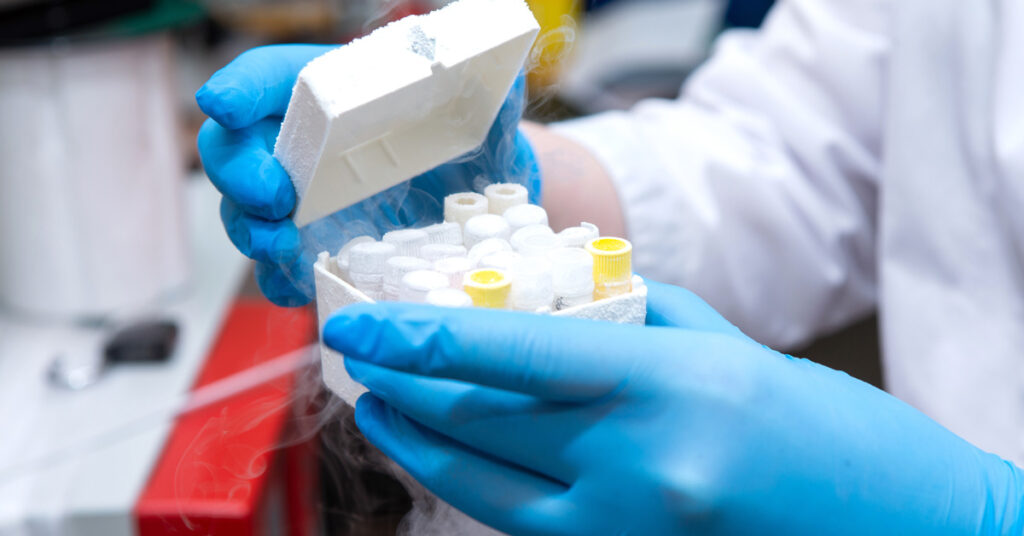
After retrieval, mature eggs are frozen using a rapid-freezing method called vitrification, which cools the eggs so quickly that ice crystals, which can damage a cell’s structure, do not have time to form. Vitrification replaced the older slow-freeze method largely because it better protects the egg’s internal structure during the freeze and thaw process. Eggs are then stored in liquid nitrogen until you are ready to use them. We go into more detail on how this technology has evolved in our piece on the latest advancements in egg freezing technology.
What the Benefits of Frozen Eggs Actually Look Like
“Benefits” is a broad word, so it helps to translate it into what it actually changes for you in practical terms.
Flexibility on Your Own Timeline
The clearest practical benefit is timing. Once eggs are frozen, you are not working against a ticking clock in the same way. You can move forward with fertility treatment when your life circumstances, whether that is a partner, financial readiness, or simply personal timing, line up, rather than feeling pressured to make a decision before you feel ready.
Preserving Egg Quality From a Younger Age
Egg quality and quantity naturally decline with age, and freezing eggs at a younger age means that decline effectively pauses for those particular eggs. When you later use frozen eggs in an IVF cycle, you are working with cells that reflect your age at the time of freezing, not your age at the time of the transfer. Reproductive medicine consistently points to age at retrieval, more than age at transfer, as the strongest predictor of how eggs perform later, which is the biological reasoning behind freezing earlier rather than waiting.
More Paths to Building a Family
Frozen eggs also open up options that would not otherwise exist. They can be used later with a partner, through a gestational carrier, or as part of planning for a family that does not follow a traditional timeline. We are proud to support LGBTQI+ family-building, and frozen eggs are often part of that plan. Our overview of fertility options for same-sex couples covers how egg freezing fits alongside donor eggs, reciprocal IVF, and surrogacy.
Setting Realistic Expectations About Egg Freezing
Egg freezing preserves potential. It does not guarantee a future pregnancy, and it is worth understanding why before you commit to the process. Not every retrieved egg survives the freeze and thaw cycle, not every thawed egg fertilizes, and not every fertilized egg develops into an embryo capable of implanting. Age at the time of freezing, the number of eggs retrieved, and individual biology all factor into the odds at each stage.
This is one reason our team talks through expected egg yield and realistic planning with every patient before a cycle begins, rather than presenting a single number as a promise. The American Society for Reproductive Medicine removed the “experimental” label from oocyte cryopreservation in 2012 after reviewing years of outcomes data, and its ethics guidance on planned egg freezing is a useful starting point if you want to read more about how the medical field frames the procedure’s role and its limits.
Why Patients Choose Chedid Grieco
Dr. Silvana Chedid has spent more than 30 years in reproductive medicine and introduced ICSI to Brazil, and our team has helped guide almost 9,000 babies into the world through fertility treatment. A few things set our approach apart for people considering egg freezing:
- We hold FDA and New York State Department of Health licensing, and our Brazil-based clinic is one of only eight facilities outside the United States to hold an NY tissue license.
- We perform roughly 1,200 treatment cycles a year, giving our team deep, ongoing experience with egg freezing and IVF protocols.
- Our practice is female-led and proudly supports LGBTQI+ family-building at every stage.
- Treatment plans are boutique and individualized rather than run on a single standard protocol.
- Consultations take place in Miami, with treatment carried out at our fully licensed Brazil clinic.
Discuss Your Frozen Egg Options With Chedid Grieco
Dr. Chedid’s three decades in reproductive medicine, her role introducing ICSI to Brazil, and a track record that includes almost 9,000 babies born through our care all inform how our team approaches egg freezing. We do not treat it as a single transaction. We treat it as one part of a longer conversation about your options, your timeline, and what a realistic path forward looks like for you.
If you are weighing egg freezing as part of your own family-building plans, our fertility tourism page walks through what to expect when consultations happen in Miami and treatment happens at our Brazil clinic. When you are ready to talk through your specific situation, reach out through our contact form.
Frequently Asked Questions About Egg Freezing
What is egg freezing and how does it work?
Egg freezing, also called oocyte cryopreservation, involves stimulating the ovaries with hormonal medication to produce multiple mature eggs, retrieving those eggs in a short outpatient procedure, and then freezing them using a rapid technique called vitrification. The eggs are stored until you decide to use them in a future IVF cycle, allowing you to preserve eggs collected during a given point in your reproductive years.
At what age should I consider freezing my eggs?
There is no single age that is right for everyone, since egg quantity and quality decline gradually and vary by individual. Many people choose to freeze eggs in their late twenties through mid-thirties, when egg quality tends to be higher, but the right timing depends on your personal circumstances, health history, and family-building goals. A consultation can help you understand where you stand.
How many eggs should I freeze?
The right number depends on your age at the time of freezing, your ovarian reserve, and how many future pregnancy attempts you want to plan for, since not every egg survives freezing, fertilizes, or develops into a viable embryo. Some people complete one stimulation cycle, while others choose to do more than one to build a larger reserve. Our team can walk through what makes sense based on your individual testing.
Does egg freezing guarantee a future pregnancy?
No. Egg freezing preserves the potential to use those eggs later, but it does not guarantee a live birth. Outcomes depend on factors such as the age at which the eggs were frozen, how many eggs were retrieved, and how the eggs perform through thawing, fertilization, and embryo development. We talk through realistic expectations with every patient rather than promising a specific result.
What happens to frozen eggs after they are thawed?
Once you are ready to proceed, stored eggs are thawed and evaluated for survival. Surviving eggs are fertilized using a sperm sample, typically through intracytoplasmic sperm injection, and the resulting embryos are monitored for development before one is selected for transfer. Any additional embryos can often be frozen for possible future use, depending on your treatment plan.
Can frozen eggs be used with a partner or through surrogacy later?
Yes. Frozen eggs can later be fertilized with a partner’s sperm or donor sperm and used in your own IVF cycle, or the resulting embryos can be carried by a gestational carrier when that fits your family-building plan. This flexibility is part of why frozen eggs are often part of the picture for LGBTQI+ patients and others exploring nontraditional paths to parenthood.
ABOUT THE AUTHOR
Reproductive Medicine Specialist, Chedid Grieco
Dr. Silvana Chedid has over 30 years of experience in reproductive medicine and has helped nearly 9,000 families grow through advanced fertility treatments at Chedid Grieco.
Recent Posts