


IVM Success Rates by Age: What the Data Shows for Women in Their 30s vs. 40s
Medically Reviewed by Dr. Silvana Chedid on September 3, 2026

Age is one of the most significant factors in any fertility treatment, and in vitro maturation is no exception. Women researching IVM often want to know specifically what the numbers look like for their age group, and whether the absence of ovarian stimulation changes how age affects outcomes compared to conventional IVF. The honest answer is that it does, and the distinction is worth understanding clearly before making a treatment decision.
In vitro maturation is a technique in which immature eggs are retrieved from the ovaries and matured in the lab rather than through hormone injections. At Chedid Grieco, we have offered IVM as part of our commitment to personalized, low-intervention reproductive care. With 30 years of experience and approximately 1,200 cycles performed each year, our team helps patients evaluate whether IVM is the right fit based on their specific clinical picture, including their age.
What the Research Shows for Women in Their 30s
For women in their early to mid-30s, IVM outcomes are generally comparable to what the data shows for conventional IVF in similar populations. According to the American Society for Reproductive Medicine’s committee opinion on IVM, research supports the wider clinical application of IVM and confirms that pregnancy rates in appropriately selected patients can be meaningful, particularly among women with polycystic ovary syndrome (PCOS) or a high antral follicle count. Clinical pregnancy rates in IVM studies for women in this group have ranged from roughly 30% to 45% per cycle, depending on protocol and patient profile.
Women in their late 30s tend to see some decline in outcomes, consistent with what occurs in conventional IVF as egg quality begins to shift. Studies report ongoing pregnancy rates in the 30% to 32% range for women aged 36 to 39 undergoing IVM, rates still clinically meaningful, especially when weighed against the reduced physical burden IVM carries by eliminating the injection phase.
What the Data Shows for Women in Their 40s
The picture changes meaningfully for women over 40. Research published in peer-reviewed literature consistently finds that IVM outcomes decline sharply in this age group. One commonly cited study reported no clinical pregnancies in women over 40 undergoing IVM, with significantly fewer good-quality embryos retrieved compared to younger patients. This reflects the broader reality that oocyte quantity and quality decline with age regardless of whether stimulation is used.
This does not mean women in their early 40s have no options, but it does mean IVM is less likely to be the right approach. For patients in this age range, our team has a direct conversation about which pathway offers the most realistic chance of success, whether that includes conventional in vitro fertilization, fertility preservation strategies evaluated earlier, or egg donation, which removes the age variable from the equation entirely.
Why Patient Selection Matters More Than Age Alone
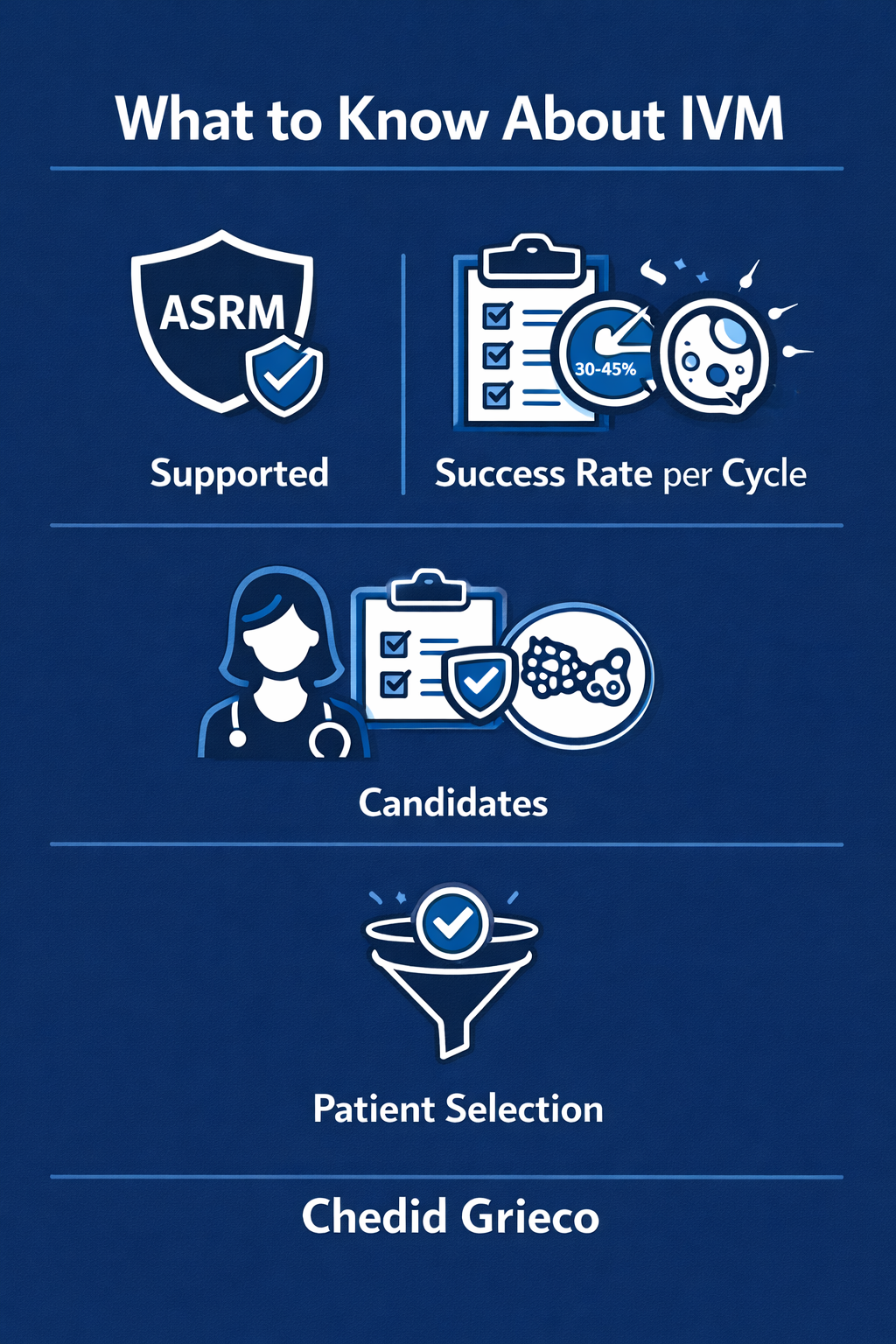
Age is a strong predictor, but it is not the only one. Antral follicle count, anti-Müllerian hormone levels, and overall ovarian reserve all influence how a patient responds to IVM, and two women of the same age can have meaningfully different clinical profiles. This is why IVM outcomes cannot be reduced to a single success rate number. The data provides a framework, and our team uses that framework alongside each patient’s individual diagnostics to make a recommendation.
IVM remains most effective for younger patients with high follicle counts, PCOS, or those for whom stimulation carries an elevated risk. For women in their late 30s, it may still be appropriate depending on reserve, but the conversation shifts toward careful evaluation. Reviewing who is an ideal candidate for IVM is a helpful first step before any consultation.
Start the Conversation With Chedid Grieco
Every treatment plan we build is centered on the individual, with full consideration of age, hormone levels, medical history, and personal priorities. With 30 years of experience, 8,780 babies born, and approximately 1,200 cycles performed each year, our team brings the depth of clinical knowledge needed to evaluate whether IVM is the right fit for you. We are FDA and NYDH licensed, which means our patients benefit from the same rigorous standards applied to top-tier fertility care in the United States. Consultations are held in Miami, FL, and treatments are conducted in Brazil.
Our fertility tourism page explains how we support patients through every step of that process, from initial consultation to treatment abroad. If you are ready to find out whether IVM is right for you, we welcome you to contact our office and speak with our team directly.
Frequently Asked Questions About IVM Success Rates
Is IVM ever recommended for women over 40?
It’s less likely to be the recommended approach, since research shows outcomes decline sharply in this age group. Your care team will discuss alternatives such as conventional IVF or egg donation if IVM isn’t the best fit for your situation.
Does having PCOS improve my chances with IVM?
Women with PCOS or a high antral follicle count are often good candidates for IVM, since these patients tend to have more immature eggs available for retrieval. Your individual profile is assessed during consultation to confirm candidacy.
What factors matter more than age when evaluating IVM candidacy?
Antral follicle count, anti-Müllerian hormone levels, and overall ovarian reserve all shape how a patient is likely to respond to IVM, and two patients of the same age can have very different profiles.
What alternatives exist if IVM isn’t recommended for me?
Depending on your clinical picture, your team may discuss conventional IVF, fertility preservation strategies, or egg donation. Each pathway is evaluated based on your individual diagnostics rather than age alone.
About the Author
Reproductive Medicine Physician, Chedid Grieco
Dr. Silvana Chedid has practiced reproductive medicine for more than 25 years and introduced Intracytoplasmic Sperm Injection (ICSI) to Brazil. She leads the clinical team at Chedid Grieco, which holds consultations in Miami and provides treatment at an FDA- and NYDH-licensed facility in Sao Paulo, Brazil.
Recent Posts